Physical Address
304 North Cardinal St.
Dorchester Center, MA 02124
Physical Address
304 North Cardinal St.
Dorchester Center, MA 02124

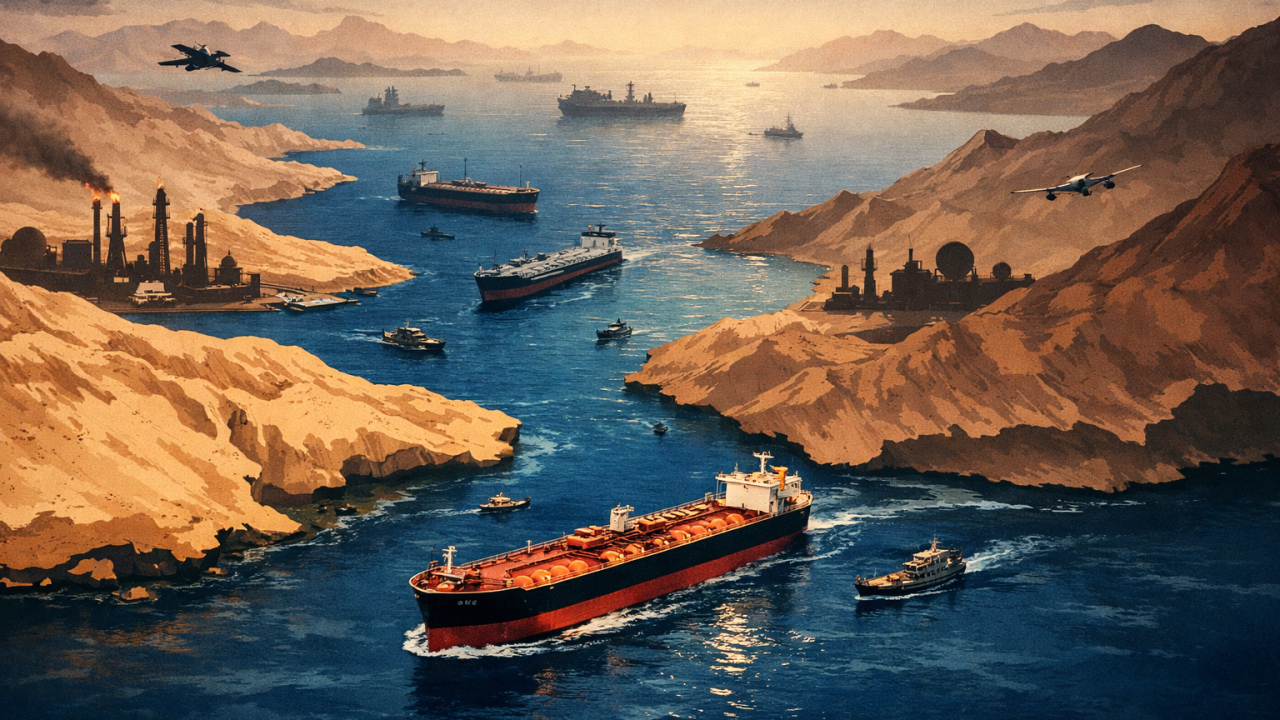
Tensions in the Middle East escalated sharply after a series of military confrontations involving Iran and Western-aligned forces in the region, raising fears that the conflict could spill into critical energy infrastructure. In response to the escalation, security risks around the Strait of Hormuz — the world’s most important oil transit corridor — surged, leading shipping companies, insurers, and energy traders to reassess the safety of tanker movements.
📊 Stat to start:
Nearly 20% of the world’s oil supply moves through the Strait of Hormuz — roughly 20 million barrels per day. When that chokepoint is disrupted, the impact goes far beyond energy.
It becomes a macro event.
Markets are now beginning to price that possibility.
The Strait of Hormuz is the single most critical maritime chokepoint in the global energy system.
Every day it channels:
Unlike other trade routes, Hormuz has no real substitute. If flows slow, oil cannot simply reroute elsewhere.
It must either wait, be stored, or not move at all.
That constraint is what creates the market shock mechanism.
The immediate spike in oil prices reflects something deeper than a physical shortage.
Energy markets price three components:
1️⃣ Current supply
2️⃣ Expected future supply
3️⃣ Geopolitical risk premium
The third component is now expanding rapidly. Even if the physical disruption remains limited, traders price the possibility of:
This risk premium alone can push crude prices sharply higher.
One of the most underestimated effects of geopolitical disruptions is shipping friction.
When risk increases in a strategic route:
This creates a logistical amplification effect. Even if oil production remains stable, less oil can reach global markets efficiently. And markets price availability, not just production.
Oil shocks rarely remain isolated to the energy sector. Energy sits upstream of almost every industrial activity.
Higher oil prices propagate through:
The result is often a second-round inflation effect.
Not immediate — but persistent.
Geopolitical energy shocks historically trigger sector-level repricing.
Typical patterns include:
🟢 Outperformance
🔴 Underperformance
Equity markets begin to reprice cost structures long before macro data reflects it.
Central banks were already navigating a fragile balance between inflation and slowing growth. An energy shock complicates that path.
Higher oil prices typically translate into:
In prolonged cases, energy shocks can produce stagflation-like dynamics. This is why oil remains one of the most important macro variables in financial markets.
Adding to the uncertainty, Donald Trump recently suggested the possibility of cutting trade ties with Spain, highlighting how trade policy risks are also re-entering the global narrative.
Even when political statements do not immediately translate into policy, they reinforce a broader trend:
global trade is becoming more politicized.
Energy disruptions and trade tensions together can significantly increase market volatility.
The key question is no longer whether disruption exists. It’s how long it lasts.
Markets are monitoring several signals closely:
If disruptions persist, the current energy shock could evolve into a broader macro regime shift.
Global markets often assume stability in the systems that support globalization. But the reality is different.
A narrow waterway.
A geopolitical flashpoint.
A disruption in energy flows.
And suddenly the entire global economy begins repricing risk.