Physical Address
304 North Cardinal St.
Dorchester Center, MA 02124
Physical Address
304 North Cardinal St.
Dorchester Center, MA 02124
In a world obsessed with SaaS, hyper-scalable platforms, and AI-powered workflows, it’s easy to forget that many of the most enduring business models still begin with something very tangible: physical products.
My career and interests have always leaned toward technology, finance, and digital platforms, yet one of the businesses I’ve run the longest looks nothing like the typical fintech playbook: vending machines.
It started with a simple idea back in Ecuador, very low-tech… yet surprisingly profitable. And today, I still operate it remotely.
But operating a physical-product business at a distance teaches you things that SaaS never will.
The biggest constraint when running a vending business remotely is simple:
👉 distance limits scalability.
Whereas SaaS scales horizontally with code, a vending business scales through capital expenditure, physical presence, and operational precision. Each machine is an asset. Its ROI depends on location, footfall, logistics, restocking cycles, shrinkage, and downtime.
In physical businesses, geography becomes a KPI.
This is why many entrepreneurs avoid tangible products: Scaling requires proximity, oversight, and trust.

Here’s the paradox:
Even if the operational burden is higher, the strategic upside can be much bigger than most people realise.
Physical businesses sit at the intersection of:
And any business embedded in daily behaviour is a gateway to cross-selling, adjacent revenue models, and—eventually—digitalisation.
Think about Visa and Mastercard.
They didn’t start as “payment platforms.” They started by solving very physical problems:
👉 enabling stores to accept cards and consumers to pay without cash.
The digital rails came later.
Your product may be physical, but the ecosystem around it is digital.
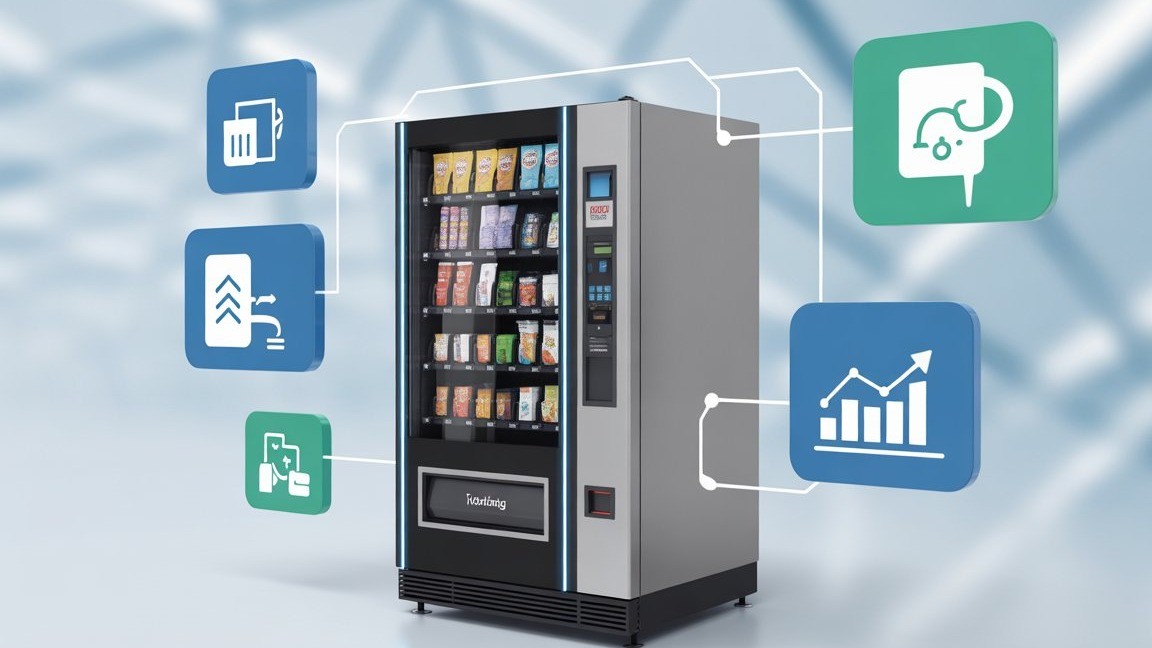
Vending machines are a great example. On paper: a box that sells snacks.
In reality: A distribution node, a data-generating device, a retail point, and a media asset.
Here is where the SaaS mindset comes in.
A vending business can unlock additional verticals such as:
Screens, side panels, NFC interactions.
Brands pay for placement, footfall, and micro-content.
CPM monetisation through a machine? Absolutely.
Real-time analytics → stockouts → demand forecasting.
Sell this to other operators.
Sensor data predicting failure events → downtime reduction.
Another SaaS layer.
Cashless terminals → digital wallets → micro-transactions.
Once you control the POS, you control the payment experience.
Supplier financing, BNPL for operators, or smart card systems for corporates.
A “simple machine” becomes a multi-product ecosystem.
This is why starting with a physical product doesn’t limit you—it actually gives you routes into digital leverage that pure-software businesses never see firsthand.
Is a vending business profitable? Yes.
Is it genuinely passive? Only if you’re satisfied with slow, incremental growth.
If you want scale, you need:
Presence—either your own or through a network—is the multiplier.
The world might be globalised, but physical assets still demand physical discipline.
This is the real message.
You shouldn’t fear starting a business with physical components.
You should fear not digitalising it early enough.
Digitalisation offers three competitive advantages:
Even the simplest physical business becomes a powerful engine for:
🧠 AI automation
Today, software is not the replacement for physical businesses—it’s the multiplier.
Starting with a vending machine taught me more about scalability, customer behaviour, unit economics, and digital strategy than any SaaS company I’ve been in.
It showed me that the real opportunity in entrepreneurship lies not in choosing physical vs digital, but in understanding how physical assets become digital platforms over time.
This mindset—hybrid, tech-augmented, operationally disciplined—is where the next generation of entrepreneurs will thrive.
🔗 Want more content like this? Subscribe to the Ascendit newsletter and join a community building smarter businesses in the digital age.